
Model description:
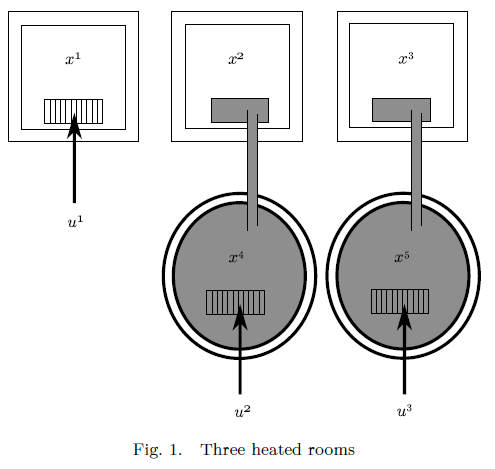
Consider three heated rooms depicted in the attached image. The first room can be heated directly by the input $u^1$, the heat transfer into the room. The other two rooms are heated via two boilers with the inputs $u^2$ and $u^3$ respectively. The temperature of each room is described by $x^1$, $x^2$, and $x^3$ respectively, the temperature of each boiler by $x^4$ and $x^5$. The heat emission of each room is considered as a nonlinear function of the room temperature. With $x = (x^1,\ldots, x^5)^{\mathrm T}$ the the nonlinear system has the form
$$\dot{x}=\begin{pmatrix} -c_0(x^2-T_0)-c_1(x^1-T_0)^2\\ -c_0(x^2-T_0)-c1(x^2-T_0)^2 + c_2(x^4-x^2)\\ -c_0(x^3-T_0)-c1(x^3-T_0)^2 + c_2(x^5-x^3)\\ -c_2(x^4-x^2)\\ -c_2(x^5-x^3) \end{pmatrix} + \begin{pmatrix} 1 & 0 & 0\\ 0 & 0 & 0\\ 0 & 0 & 0\\ 0 & 1 & 0\\ 0 & 0 & 1 \end{pmatrix} \begin{pmatrix} u^1\\ u^2\\ u^3 \end{pmatrix}, $$
where $c_0$, $c_1$, and $c_2$ are parameters for the heat transmission, and $T_0$ is the temperature outside of the rooms. We will choose our parameters so that the time is measured in hours and $x^i$ is measured in Kelvin. The state manifold is $\mathcal{M}= \mathbb{R}^5$, and the coupling conditions are
$y=h(x)=\begin{pmatrix}x^1-x^2\\x^1-x^3\end{pmatrix}=0,$
i.e. the temperature of the three rooms should be equal.
Type:
Form:
Model order:
Time domain:
Linearity:
Attachment:

Publication details:
| Title | Attractive Invariant Submanifold-based Coupling Controller Design |
| Publication Type | Conference Paper |
| Year of Publication | 2011 |
| Authors | Labisch, Daniel, and Konigorski Ulrich |
| Conference Name | 2011 50th IEEE Conference on Decision and Control and European Control Conference (CDC-ECC) Orlando, FL, USA |
| Date Published | 12/2011 |
| Publisher | IEEE |
| Conference Location | Orlando, FL |
| ISBN Number | 978-1-61284-800-6 |
| Accession Number | 12590357 |
| Keywords | control system synthesis, multivariable control systems, nonlinear control systems |
| Abstract | In this paper, we provide an algorithm for the design of a coupling controller for a nonlinear input-affine system. The resulting controller renders the maximal locally controlled invariant output-nulling submanifold locally attractive for the controlled system. The connections to the constrained dynamics algorithm and the triangular decoupling problem are presented, and necessary and sufficient conditions for the success of the new algorithm are derived. |
| DOI | 10.1109/CDC.2011.6160421 |