Analysing the properties of a biological system through in silico experimentation requires a satisfactory mathematical representation of the system including accurate values of the model parameters. Fortunately, modern experimental techniques allow obtaining time-series data of appropriate quality which may then be used to estimate unknown parameters. However, in many cases, a subset of those parameters may not be uniquely estimated, independently of the experimental data available or the numerical techniques used for estimation. This lack of identifiability is related to the structure of the model, i.e. the system dynamics plus the observation function. Despite the interest in knowing a priori whether there is any chance of uniquely estimating all model unknown parameters, the structural identifiability analysis for general non-linear dynamic models is still an open question. There is no method amenable to every model, thus at some point we have to face the selection of one of the possibilities. This work presents a critical comparison of the currently available techniques. To this end, we perform the structural identifiability analysis of a collection of biological models. The
results reveal that the generating series approach, in combination with identifiability tableaus, offers the most advantageous compromise among range of applicability, computational complexity and information provided.
The model describes the oscillations in enzyme kinetics. The state variable $x_1$ represents an enzyme concentration whose rate of synthesis is regulated by feedback control via a metabolite $x_3$, and $x_2$ regulates the synthesis of $x_3$. It is characterised by a rational kinetics consisting of a Hill-like term, and it is given by:
Analysing the properties of a biological system through in silico experimentation requires a satisfactory mathematical representation of the system including accurate values of the model parameters. Fortunately, modern experimental techniques allow obtaining time-series data of appropriate quality which may then be used to estimate unknown parameters. However, in many cases, a subset of those parameters may not be uniquely estimated, independently of the experimental data available or the numerical techniques used for estimation. This lack of identifiability is related to the structure of the model, i.e. the system dynamics plus the observation function. Despite the interest in knowing a priori whether there is any chance of uniquely estimating all model unknown parameters, the structural identifiability analysis for general non-linear dynamic models is still an open question. There is no method amenable to every model, thus at some point we have to face the selection of one of the possibilities. This work presents a critical comparison of the currently available techniques. To this end, we perform the structural identifiability analysis of a collection of biological models. The
results reveal that the generating series approach, in combination with identifiability tableaus, offers the most advantageous compromise among range of applicability, computational complexity and information provided.
Consider the model from Dynamic Model of Tumor Growth (1). The complete model formulation describes the phenomenology of tumor growth slowdown, as the tumor consumes its available support; stimulatory and inhibitory influences from the tumor cells; inhibition due to administered inhibitors; and the clearance of the administered inhibitor. In the simplified model, the latter effect is not described, only the serum level of the inhibitor to be maintained is represented, so a second-order system is to be analyzed:
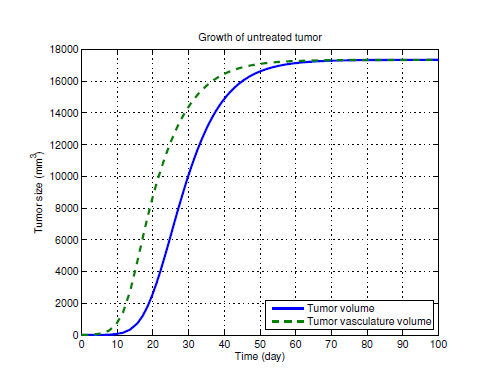
where $x_1$ is the tumor volume (mm$^3$), $x_2$ is the vasculature volume (mm$^3$), and $u$ is the serum level of the inhibitor (mg/kg). The last equation represents that tumor volume is the measured output of the system. The characteristics of the parameters for the Lewis lung carcinoma and the mice used in the experiment are: $\lambda = 0.192($day$^{-1})$, $b = 5.85 ($day$^{−1}),$ $d =0.00873 ($day$^{−1}$mm$^{−2}),$ while the parameter characteristic for the inhibitor (endostatin) is: $e = 0.66 ($day$^{−1} ($mg/kg$)^{−1}).$ Attached figure shows the nonlinear behavior of the simplified model.
In the last decades beside conventional cancer treatment methods, molecular targeted therapies show prosperous results. These therapies have limited side-effects, and in comparison to chemotherapy, tumorous cells show lower tendency of becoming resistant to the applied antiangiogenic drugs. In clinical research, antiangiogenic therapy is one of the most promising cancer treatment methods. Using a simplified model of the reference dynamical model for tumor growth under angiogenic inhibition from the literature, exact linearization is performed in the paper to handle the nonlinear behavior of the model. Two different control methods are applied on the linearized model: flat control and switching control. Simulations are performed on the nonlinear model to show the characteristics of the therapies carried out using the presented control methods.
In 1999, a research was carried out at the Harvard Medical University by Philip Hahnfeldt et al. to investigate experimentally and theoretically the effects of angiogenic inhibitors on tumor growth dynamics. They posed a quantitative theory for tumor growth under angiogenic stimulator/inhibitor control. In their experiments, mice were injected with Lewis lung carcinoma cells. The following equations comprise the entire model formulation:
where $x_1$is the tumor volume (mm$^3$), $x_2$is the supporting vasculature volume (mm$^3$), $x_3$ is the inhibitor serum level (mg/kg), and $u$ is the inhibitor administration rate (mg/kg/day).
In the last decades beside conventional cancer treatment methods, molecular targeted therapies show prosperous results. These therapies have limited side-effects, and in comparison to chemotherapy, tumorous cells show lower tendency of becoming resistant to the applied antiangiogenic drugs. In clinical research, antiangiogenic therapy is one of the most promising cancer treatment methods. Using a simplified model of the reference dynamical model for tumor growth under angiogenic inhibition from the literature, exact linearization is performed in the paper to handle the nonlinear behavior of the model. Two different control methods are applied on the linearized model: flat control and switching control. Simulations are performed on the nonlinear model to show the characteristics of the therapies carried out using the presented control methods.
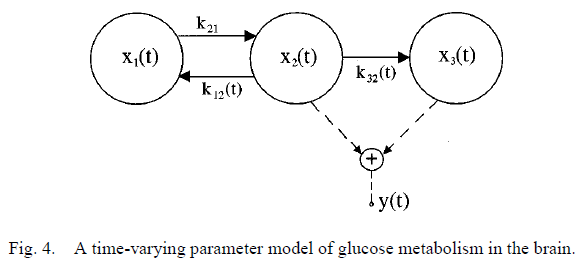
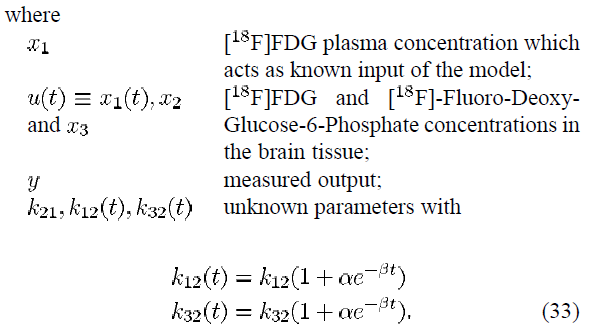
The model we discuss here has been proposed to study glucose metabolism in the brain from positron emission tomography (PET) [$^{18}$F]-Fluoro-Deoxy-Glucose($^{18}$F-FDG) data K. Schmidt, G. Mies, and L. Sokoloff, “Model of kinetic behavior of deoxyglucose in heterogeneous tissues in brain: A reinterpretation of the significance of parameters fitted to homogeneous tissue models,” J. Cereb. Blood Flow Metab., vol. 11, pp. 10–24, 1991. The model is shown in Fig. 4. It is a two compartment model with two time-varying parameters which account for brain tissue heterogeneity.
A prerequisite for well-posedness of parameter estimation of biological and physiological systems is a priori global identifiability, a property which concerns uniqueness of the solution for the unknown model parameters. Assessing a priori global identifiability is particularly difficult for nonlinear dynamic models. Various approaches have been proposed in the literature but no solution exists in the general case. Here, the authors present a new algorithm for testing global identifiability of nonlinear dynamic models, based on differential algebra. The characteristic set associated to the dynamic equations is calculated in an efficient way and computer algebra techniques are used to solve the resulting set of nonlinear algebraic equations. The algorithm is capable of handling many features arising in biological system models, including zero initial conditions and time-varying parameters. Examples of usage of the algorithm for analyzing a priori global identifiability of nonlinear models of biological and physiological systems are presented.