Continuously stirred tank reactor system

Deprecation warning

This website is now archived. Please check out the new website for Centre for Intelligent Systems which includes both A-Lab Control Systems Research lab and Re:creation XR lab.

However, the Dynamic System Model Database can still be used and may be updated in the future.

Hopping robot - Flight

Model description: 

$$\dot{x}=A_Fx+b_F\tau+e_F(x)$$

with

$A_S = \begin{bmatrix} 0 & 1 & 0 & 0 \\ 0 & 0 & -K \dfrac{m_n}{\beta_F} & -C \dfrac{m_n}{\beta_F} \\ 0 & 0 & 0 & 1 \\ 0 & 0 & -K \dfrac{m_{bnt}}{\beta_F} & -C \dfrac{m_{bnt}}{\beta_F} \\ \end{bmatrix},\\ x = \begin{bmatrix} z\\ \dot{z}\\ p\\ \dot{p} \end{bmatrix}, b_F = \dfrac{\eta}{\beta_{F}r} \begin{bmatrix} 0\\ m_n\\ 0\\ m_{bn} \end{bmatrix},\\ e_F(x)=\dfrac{1}{\beta_F} \begin{bmatrix} 0\\ \alpha(m_{bnt}g + f_{fF} + m_n(m_ng - k(s_0 - l_0) - f_p))\\ 0\\ -m_nf_{fF} - m_{bnt}(k(s_0-l_0) + f_a)\\ \end{bmatrix}. $

$z$ Body Height
$p$ Actuator Length
$\tau$ Motor Torque
$\theta$ Motor angle, $\theta = p/r$
$s$ Spring Length
$m_b$ 9.5kg Upper Leg Mass
$m_n$ 0.25kg Ball Nut Mass
$m_t$ 0.5kg Toe Mass
$k$ 400 N/m Spring Constant
$F_p$ 5.0N Leg Dry Friction
$F_z$ 1.5N Planarized Dry Friction
$F_a$ 0N Ball Screw Dry Friction
$c$ 5.5Ns/m Spring Viscous Friction
$\hat{\tau}$ 1.78Nm Stall Torque
$\hat{\omega}$ 2800RPM Max Speed
$\eta$ 0.95 Ball Screw Efficiency
$s_0$ 0.608m Spring Rest Length
$l_0$ 0.595m Maximum Leg Length
$J$ 2.7$\times$10$^{-4}$kgm$^2$ Motor Inertia
$\alpha$ 0.34kgm $J/r^2+m_n$
$\mu$ 0.05 $m_t/m_{bnt}$

Type: 

Form: 

Model order: 

4

Time domain: 

Linearity: 

Attachment: 

Publication details: 

TitleDesign, modeling and control of a hopping robot
Publication TypeConference Paper
Year of Publication1993
AuthorsRad, H., Gregorio P., and Buehler M.
Conference NameProceedings of the 1993 IEEE/RSJ International Conference on Intelligent Robots and Systems '93, IROS '93.
Date Published06/1993
PublisherIEEE
Conference LocationYokohama
ISBN Number0-7803-0823-9
Accession Number5050001
Keywordslegged locomotion
AbstractThe authors report progress towards model based, dynamically stable legged locomotion with energy efficient, electrically actuated robots. The present the mechanical design of a prismatic robot leg which is optimized for electrical actuation. A dynamical model of the robot and the actuator as well as the interaction with ground is derived and validated by demonstrating close correspondence between simulations and experiments. A new continuous, and exactly implementable open loop torque control algorithm is introduced which stabilizes a limit cycle of the underlying fourth order intermittent robot/actuator/environment dynamics
DOI10.1109/IROS.1993.583877

Hopping robot - Stance

Model description: 

$$\dot{x}=A_Sx+b_S\tau+e_S(x)$$

with

$A_S = \begin{bmatrix} 0 & 1 & 0 & 0 \\ -K\dfrac{J}{\beta_Sr^2} & -C\dfrac{J}{\beta_Sr^2} & K\dfrac{J}{\beta_Sr^2} & C\dfrac{J}{\beta_Sr^2} \\ 0 & 0 & 0 & 1 \\ K\dfrac{m_b}{\beta_s} & C\dfrac{m_b}{\beta_s} & -K\dfrac{m_b}{\beta_s} & -C\dfrac{m_b}{\beta_s} \\ \end{bmatrix},\\ x = \begin{bmatrix} z\\ \dot{z}\\ p\\ \dot{p} \end{bmatrix}, b_S = \dfrac{\eta}{\beta_{S}r} \begin{bmatrix} 0\\ m_n\\ 0\\ m_{bn} \end{bmatrix},\\ e_S(x)=\dfrac{1}{\beta_s} \begin{bmatrix} 0\\ \alpha(ks_0 - m_{bn}g- f_{fS} + m_n(m_ng - ks_0 - f_a)\\ 0\\ 0\\ \end{bmatrix}. $

$z$ Body Height
$p$ Actuator Length
$\tau$ Motor Torque
$\theta$ Motor angle, $\theta = p/r$
$s$ Spring Length
$m_b$ 9.5kg Upper Leg Mass
$m_n$ 0.25kg Ball Nut Mass
$m_t$ 0.5kg Toe Mass
$k$ 400 N/m Spring Constant
$F_p$ 5.0N Leg Dry Friction
$F_z$ 1.5N Planarized Dry Friction
$F_a$ 0N Ball Screw Dry Friction
$c$ 5.5Ns/m Spring Viscous Friction
$\hat{\tau}$ 1.78Nm Stall Torque
$\hat{\omega}$ 2800RPM Max Speed
$\eta$ 0.95 Ball Screw Efficiency
$s_0$ 0.608m Spring Rest Length
$l_0$ 0.595m Maximum Leg Length
$J$ 2.7$\times$10$^{-4}$kgm$^2$ Motor Inertia
$\alpha$ 0.34kgm $J/r^2+m_n$
$\mu$ 0.05 $m_t/m_{bnt}$

Type: 

Form: 

Model order: 

4

Time domain: 

Linearity: 

Attachment: 

Publication details: 

TitleDesign, modeling and control of a hopping robot
Publication TypeConference Paper
Year of Publication1993
AuthorsRad, H., Gregorio P., and Buehler M.
Conference NameProceedings of the 1993 IEEE/RSJ International Conference on Intelligent Robots and Systems '93, IROS '93.
Date Published06/1993
PublisherIEEE
Conference LocationYokohama
ISBN Number0-7803-0823-9
Accession Number5050001
Keywordslegged locomotion
AbstractThe authors report progress towards model based, dynamically stable legged locomotion with energy efficient, electrically actuated robots. The present the mechanical design of a prismatic robot leg which is optimized for electrical actuation. A dynamical model of the robot and the actuator as well as the interaction with ground is derived and validated by demonstrating close correspondence between simulations and experiments. A new continuous, and exactly implementable open loop torque control algorithm is introduced which stabilizes a limit cycle of the underlying fourth order intermittent robot/actuator/environment dynamics
DOI10.1109/IROS.1993.583877

Generic nonlinear system

Model description: 

$$\begin{align*} \dot{x}_1 &= x_1 = x_1x_4 + \theta_1x_1^2 \theta_2x_3 + x_2u_1 + u_2 + u_3 \\ \dot{x}_2 &= x_2\cos{x_3} + \theta_3x_4 + u_1 + u_4 \\ \dot{x}_3 &= \sin{x_2} - x_3 \\ \dot{x}_4 &= x_3 - x_4 + x_1x_4 + \theta_1x_1^2 + (1 + x_2)u_1 + u_2 + u_3 \\ y_1 &= x_1 \\ y_2 &= x_2, \end{align*}$$

where $\theta_1 = 0.5$, $\theta_2 = 2$, and $\theta_3 = 1$ are unknown constant parameters.

Type: 

Form: 

Time domain: 

Linearity: 

Publication details: 

TitleVirtual Grouping based adaptive actuator failure compensation for MIMO nonlinear systems
Publication TypeJournal Article
Year of Publication2005
AuthorsTang, Xidong
JournalIEEE Transactions on Automatic Control
Volume50
Start Page1775
Issue11
Pagination1780
Date Published11/2005
ISSN0018-9286
Accession Number8646599
Keywordsactuators, adaptive control, closed loop systems, control system synthesis, failure analysis, MIMO systems, nonlinear control systems, redundancy
AbstractA new control design technique called virtual grouping is presented to handle actuator redundancy and failures for multiple-input-mutliple-output (MIMO) systems, enlarging the set of compensable actuator failures. An adaptive compensation scheme is thus developed for a class of nonlinear MIMO systems to ensure closed-loop signal boundedness and asymptotic output tracking despite unknown actuator failures. Simulation results are given to show the effectiveness of the adaptive design.
DOI10.1109/TAC.2005.858633

Electric drive with a four-pole squirrel-cage induction motor

Model description: 

The motor dynamics are mapped by aset of five highly coupled nonlinear differential equations as given by

$$\begin{align*} \dfrac{{\mathrm d}i_{qs}^r}{{\mathrm d}t} &= \dfrac{1}{L_{\Sigma}} \left[-\dfrac{L_{RM}^2r_s+M^2r_r}{L_{RM}}i_{qs}^r + \dfrac{r_rM}{L_{RM}}\Psi_{qr}^r - (L_\Sigma i_{ds}^r + M \Psi_{dr}^r) \omega_r + L_{RM}u_{qs}^r\right] \\ \dfrac{{\mathrm d}i_{ds}^r}{{\mathrm d}t} &= \dfrac{1}{L_{\Sigma}} \left[-\dfrac{L_{RM}^2r_s+M^2r_r}{L_{RM}}i_{ds}^r + \dfrac{r_rM}{L_{RM}}\Psi_{dr}^r + (L_\Sigma i_{qs}^r + M \Psi_{qr}^r) \omega_r + L_{RM}u_{ds}^r\right] \\ \dfrac{{\mathrm d}\Psi_{qr}^r}{{\mathrm d}t} &= \dfrac{r_r M}{L_{RM}}i_{qs}^r - \dfrac{r_r}{L_{RM}}\Psi_{qr}^r \\ \dfrac{{\mathrm d}\Psi_{dr}^r}{{\mathrm d}t} &= \dfrac{r_r M}{L_{RM}}i_{ds}^r - \dfrac{r_r}{L_{RM}}\Psi_{dr}^r \\ \dfrac{{\mathrm d}\omega_r}{{\mathrm d}t} &= -\dfrac{B_m}{J}\omega_r + \dfrac{P}{2J}\left[\dfrac{P}{2}\dfrac{M}{L_{RM}}(i_{qs}^r\Psi_{dr}^r - i_{ds}^r-\Psi_{qr})-T_L\right], \end{align*}$$

where $L_{\Sigma} = L_{SM}L_{RM}-M^2$. For the load torque we assume the expression $T_L=c_2\omega_r^2 + c_3\omega_r^3$.

The state vector is given by

$x(t) = [i_{qs}^r, i_{ds}^r, \Psi_{qr}^r, \Psi_{dr}^r, \omega_r]^{\mathrm T} = [x_1, x_2, x_3, x_4, x_5]^{\mathrm T}.$

Type: 

Form: 

Model order: 

5

Time domain: 

Linearity: 

Publication details: 

TitleNonlinear identification of induction motor parameters
Publication TypeConference Paper
Year of Publication1999
AuthorsPappano, V., Lyshevski S.E., and Friedland B.
Conference NameProceedings of the 1999 American Control Conference, 1999.
Date Published01/1999
PublisherIEEE
Conference LocationSan Diego, CA
ISBN Number0-7803-4990-3
Accession Number6402981
Keywordsdynamics, identification, multivariable systems, Nonlinear dynamical systems, squirrel cage motors, state-space methods, transients
AbstractIn this paper, a nonlinear mapping identification concept is applied to identify the unknown parameters of induction motors using transient dynamics. The developed identification algorithm has significant advantages due to computational efficiency, robustness and convergence, reliability and feasibility. The reported model-based state-space identification can be applied to a wide class of nonlinear multivariable continuous-time dynamic systems. To illustrate the analytical results and to demonstrate the practical capabilities, the unknown motor parameters are found for a squirrel-cage induction motor, under the assumption that all the state vector is available for measurement
DOI10.1109/ACC.1999.782431

Continuously stirred tank reactor system

Model description: 

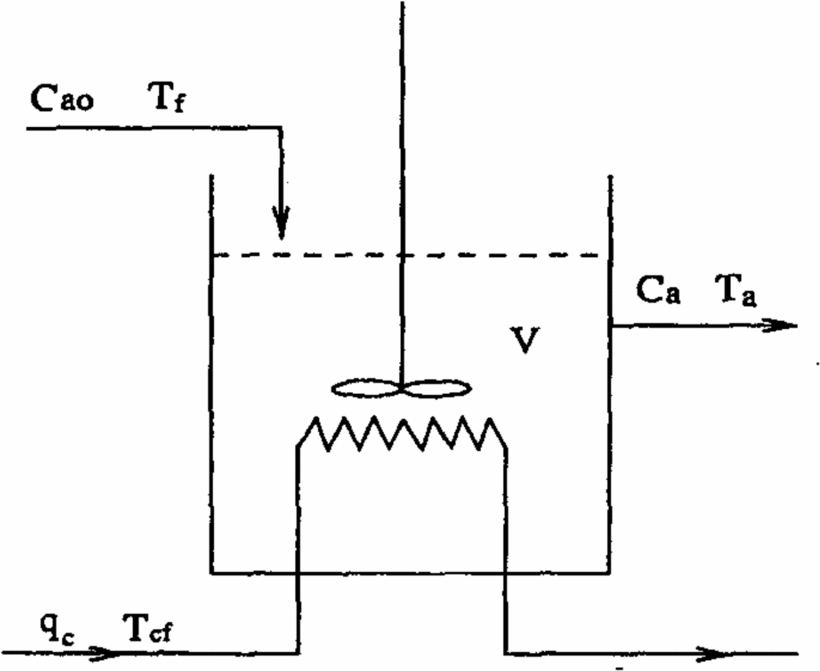
A schematic of the CSTR plant is shown in the attached image. The process dynamics are described by

$$\begin{align*} \dot{C}_{a} &=\frac{q}{V}(C_{a0}-c_{a})-a_{0}C_{a}e^{-\frac{E}{RT_{a}}} \\ \dot{T}_{a} &=\frac{q}{V}(T_{f}-T_{a})+a_{1}C_{a}e^{-\frac{E}{RT_{a}}}+a_{3}q_{c}\left(1-e^{\frac{a_{2}}{q_{c}}}\right)(T_{cf}-T_{a}), \end{align*}$$

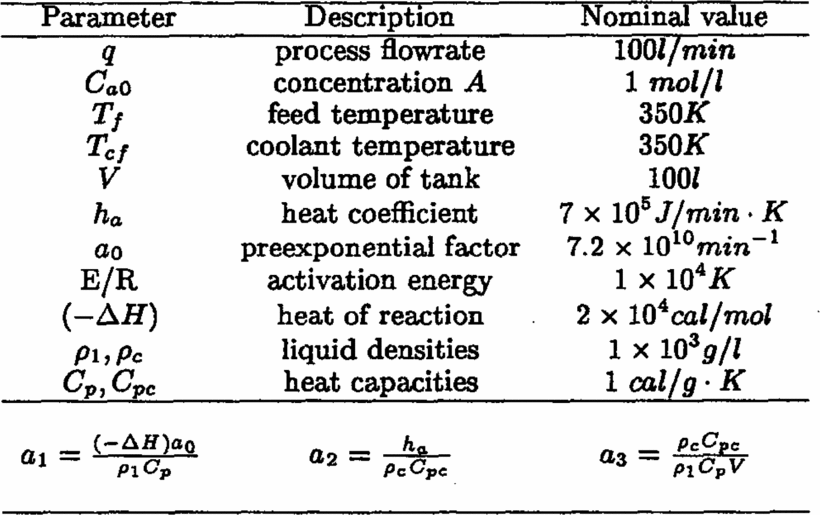
where the variables $C_a$ and $T_a$ are the concentration and temperature of the tank, respectively; the coolant flow rate $q_c$ is the control input and the parameters of the plant are defined in the attached table. Within the tank reactor, two chemicals are mixed and react to produce a product compound $A$ at a concentration $C_a(t)$ with the temperature of the mixture being $T(t)$. The reaction is both irreversible and exothermic.

In the paper, authors assumed that plant parameters $q, C_{a0}, T_f$ and $V$ are at the nominal values given in the attached table. The activation energy $E/R = 1 \times 10^4K$ is assumed to be known. The state variables the input and the output are defined as $x=[x_1,x_2]^{\mathrm T}=[C_a,T_a]^{\mathrm T},u=q_c,y=C_a$. Using this notation, the CSTR plant can be re-expressed as

$$\begin{align*} \dot{x}_{1} &=1-x_{1}-a_{0}x_{1}e^{-\frac{10^4}{{\rm a}_2}} \\ \dot{x}_{2} &=T_{f}-x_{2}+a_{1}x_{1}e^{-\frac{10^4}{{\rm a}_2}}+a_{3}u\left(1-e^{-\frac{a_2}{u}}\right)(T_{cf}-x_{2}) \\ y &= x_{1}, \end{align*}$$

where the unknown constant parameters are $a_0, a_1, a_2$ and $a_3$.

Type: 

Form: 

Time domain: 

Linearity: 

Attachment: 

Publication details: 

TitleAdaptive nonlinear control of continuously stirred tank reactor systems
Publication TypeConference Paper
Year of Publication2001
AuthorsZhang, T., and Guay M.
Conference NameProceedings of the 2001 American Control Conference, 2001.
Date Published06/2001
PublisherIEEE
Conference LocationArlington, VA
ISBN Number0-7803-6495-3
Accession Number7106659
Keywordsadaptive control, asymptotic stability, chemical technology, closed loop systems, feedback, Lyapunov methods, neurocontrollers, nonlinear control systems, process control
AbstractAdaptive nonlinear control is investigated for a class of continuously stirred tank reactor (CSTR) system. The CSTR plant under study belongs to a class of general nonlinear systems, and contains an unknown parameter that enters the model nonlinearly. Using adaptive backstepping and neural network (NN) approximation techniques, an alternative adaptive NN controller is developed that achieves asymptotic output tracking control. Both stability and control performance analysis of the closed-loop adaptive system are based on Lyapunov's stability techniques
DOI10.1109/ACC.2001.945898

Pages