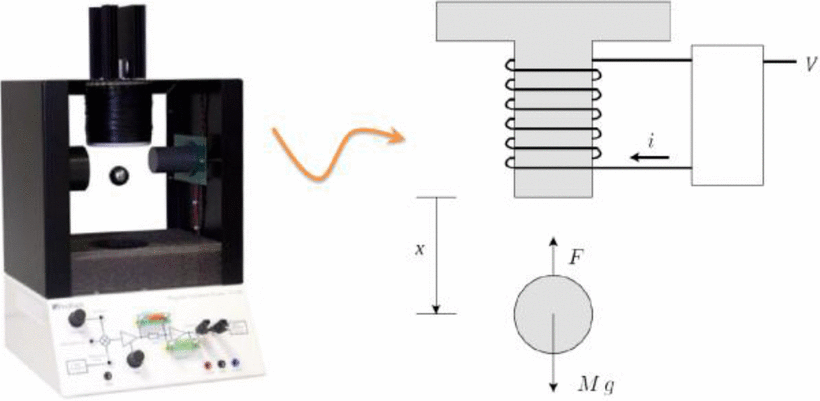
The model of the MAGLEV system is unstable and nonlinear
$$
m\ddot{x}=mg-\dfrac{K_{c}V^{2}}{x^{2}},
$$
where $x$ is the metal ball position being the system output, $V$ is the system input as the voltage. Other parameters are $m$ as the mass of the metal ball, $K_c$ as constant for magnet circuit, and $g$ is the gravitational acceleration of 9.8 m/s$^2$. A free-body diagram is shown also in the attached image.
Identification of a practical process, especially if unstable, is challenging as its model is generally stochastic and nonlinear. In this work we consider a class of unstable processes where the model is identified in a closed-loop operating regime. Important issues in identification are addressed, namely: identification scheme, the closed loop identification of unstable plants, choice of sampling period, and constraints on the estimated model parameters. Further the structure of the identified model may not be identical to that of the physical system due to noise artifacts, and inability to capture faster dynamics. Generally least-squares identification is employed to estimate the parameters of the system wherein all the coefficients of numerator and the denominator coefficients of system transfer function are estimated. In many practical system there are constraints on the model parameters. The identified coefficients using the conventional scheme may not obey the constraint. In this work a novel constrained least-squares identification scheme is proposed where in a priori known structural constraint is factored in parameter estimation. This scheme is evaluated on a physical magnetic lévitation system.
The behavior of phytoplankton cells in a continuous reactor is usually described by the Droop model. Cell growth is limited by a nutrient with concentration $S$. The biomass has a concentration $N$ and $Q$ represents the cell quota of assimilated nutrient, expressed as the amount of intracellular nutrient per biomass unit. The dilution rate $D$ corresponds to the flow rate of renewal medium over the volume of the reactor, and $D$ is the input of the system.
The authors construct nonlinear observers in order to discuss the validity of biological models. They consider a class of systems including many classical models used in biological modeling. They formulate the nonlinear observers corresponding to these systems and prove the conditions necessary for their exponential convergence. They apply these observers on the well-known Droop model which describes the growth of a population of phytoplanktonic cells. The validity of this model is discussed based on the performance of the observers working on experimental data
This paper deals with the measurement of the frequency response of the mechanical part of a drive for the parameter identification of a plant. The system is stimulated by pseudorandom binary signals. The measurement of the frequency response is part of a system identification procedure being carried out during an automatic commissioning of the drive. For the calculation of the frequency response of the mechanics, the Welch-method is applied for spectral analysis. The Welch-method is known from the fields of communications and measurement engineering. This paper addresses the application of this powerful method for the identification of electrical drives. Investigations have pointed out that the pure utilization of conventional identification strategies does not yield satisfying experimental results. Experimental results presented in this paper point out clearly the efficiency and flexibility of the proposed Welch-method. This paper contains many practical aspects and realization details that are important for their implementation on industrial systems. Although in principle, commercial software tools can be utilized for identifying the parameters of the plant, this paper addresses the implementation of the necessary identification algorithms on the embedded control electronics of the drives. The utilization of the Levenberg-Marquardt-algorithm yields excellent results for the identified parameters on the basis of the measured frequency response data.